
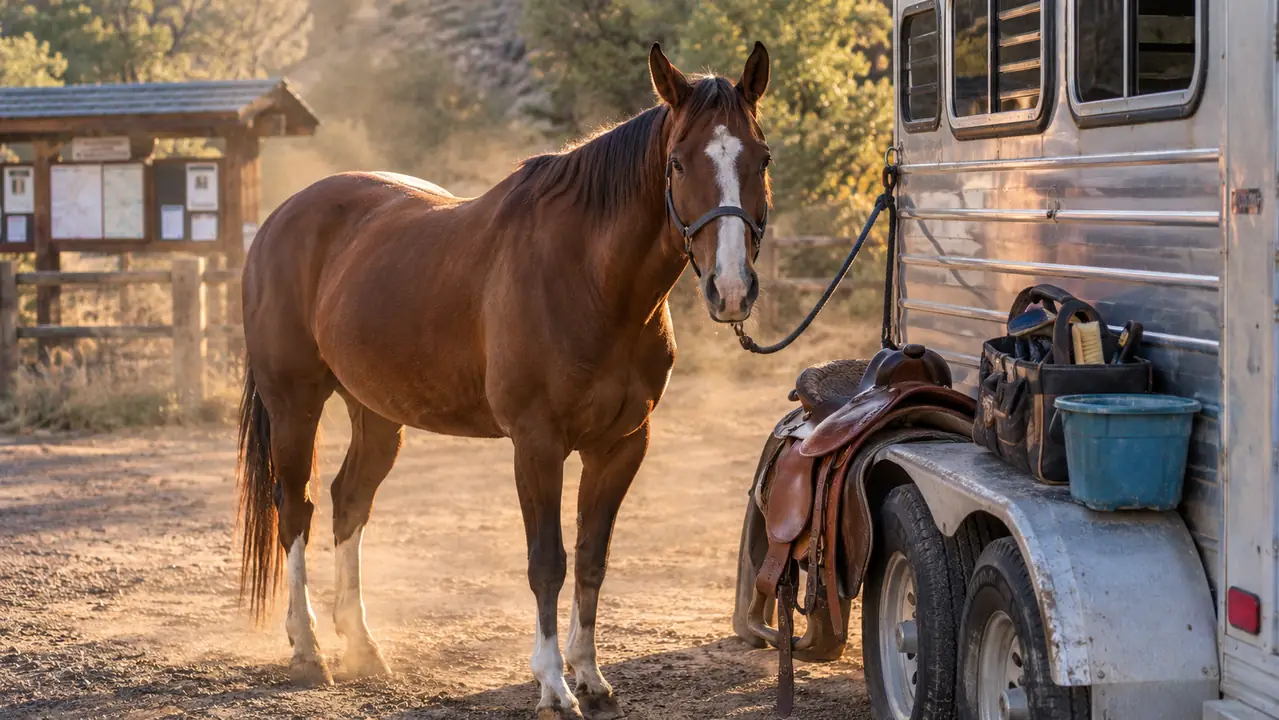
The first thing Juniper does when I pull the saddle off is drop her head and rub her sweaty face on my shoulder. That tells me two things. She had a good ride, and I have about ten minutes before she decides grooming is over and starts drifting toward the water trough. A horse coming off a summer trail is a mess: dried sweat crusted along the girth, dust worked into the coat like sandpaper, hooves packed with dirt and parking lot gravel. Skip the cleanup and I pay for it the next morning with a dull coat and a hot spot where the saddle pad sat.
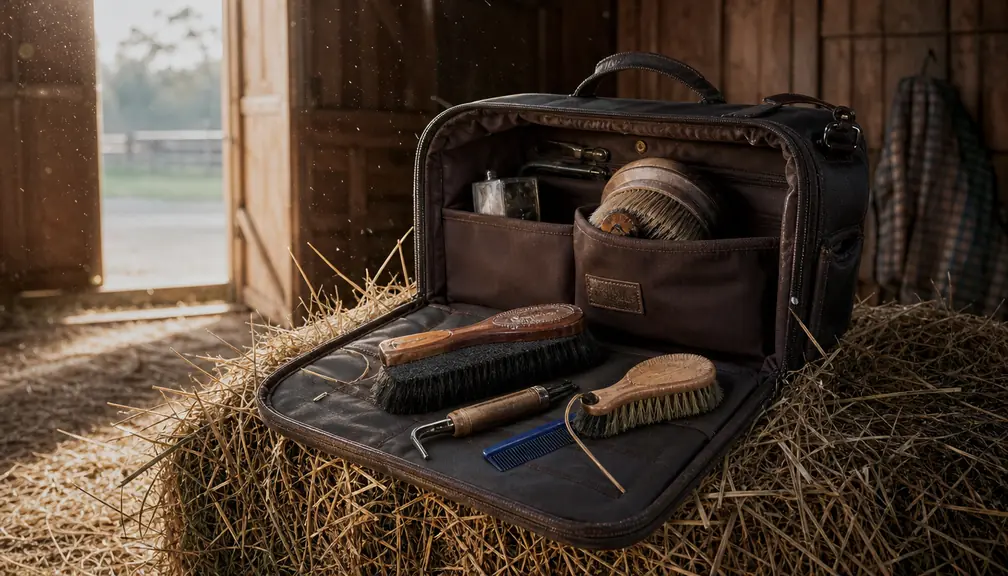
For years I groomed wrong. I grabbed whichever brush was closest, worked top to bottom, skipped the sweat scraper because it looked like extra work, and picked hooves whenever I remembered. What I got for my trouble was sweat trapped under dirt and a sore back I blamed on my saddle pad for two months. The order matters and the tools matter more than I wanted to admit. The Weaver Equine grooming kit is a 7-piece set with assorted brushes, a hoof pick, a comb and a sweat scraper, packed in a nylon tote with six outer pockets. The whole bag measures 12 by 12 by 7 inches and weighs about 2.76 pounds, so it rides on the trailer fender without sliding off on the turns.
Seven pieces, one bag, nothing left on the fender
The Weaver Equine grooming kit keeps the brushes, hoof pick, comb and sweat scraper in a single nylon tote with six outer pockets, so the twenty minutes after a ride start with everything already in your hand.
Amazon Check Today's Price on Amazon →Step 1: Let Her Cool Down and Put Your Hands on Her First
The twenty minutes after a ride are not the time to start brushing hard. I loosen the girth, pull the saddle and the pad, walk her out for ten or fifteen minutes until her breathing is normal, and let her drink. Then I run my hands over her slowly, in the same order I took the tack off. Down the neck, along the shoulders, over the back where the pad sat, around the girth line, down each leg to the hoof.
This part is not grooming. It is checking. I am feeling for heat, swelling, a cut, a rub, a bit of gravel worked under the skin, a knee that feels different than it did this morning. I am not a vet and I do not play one. If something is hot and puffy, I hose it, I keep her walking, and I call someone who knows more than I do. But I find more problems with my hands in three minutes than I ever found with a brush.
The kit helps here because the tote sits open on the fender where I can reach it. The nylon holds its shape instead of collapsing into a heap, and the six outer pockets keep the hoof pick and the comb from burying themselves under the brushes. I can do the hands-on check and then reach straight into the pocket I need without setting anything down in the dirt.
Step 2: Scrape the Sweat Before You Touch Her With a Brush
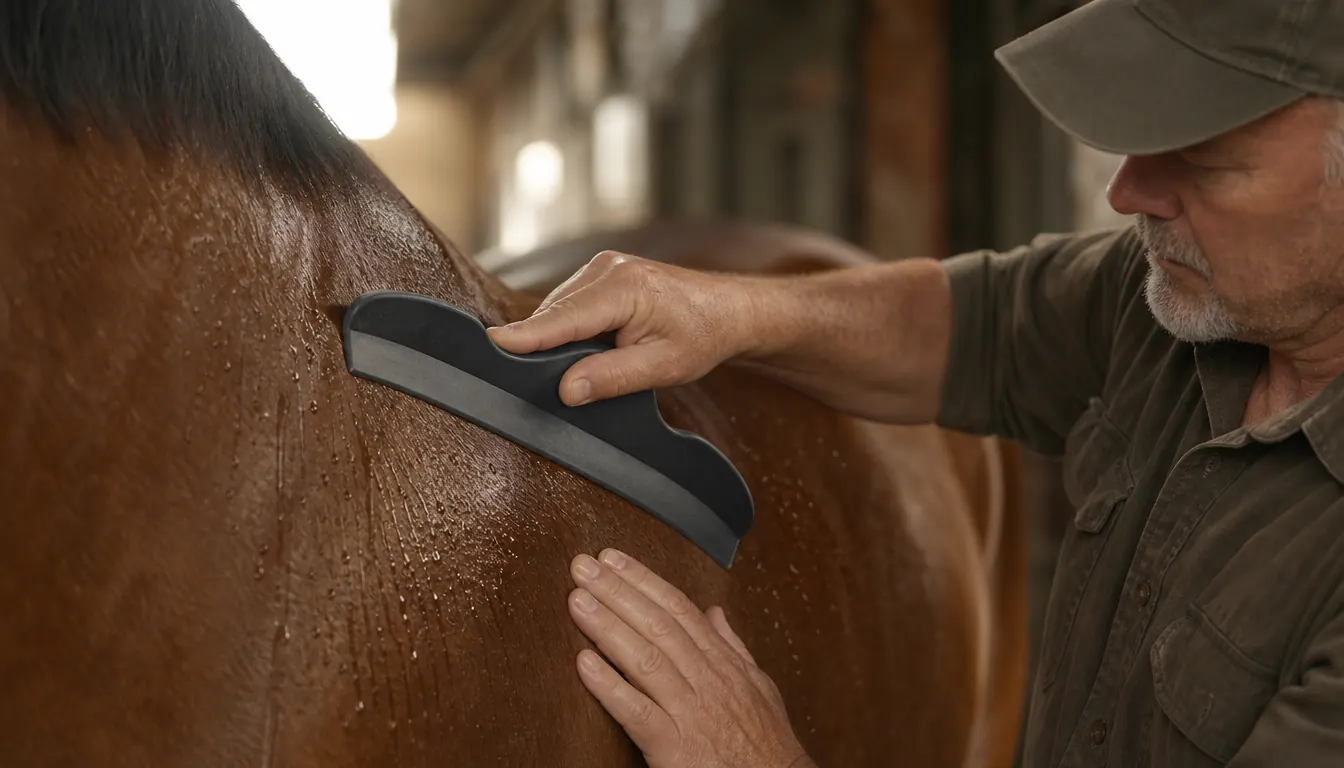
The sweat scraper is the piece most people skip and it is the one that does the most work. I run it in the direction the hair grows, in long overlapping strokes, starting at the shoulder and working back. The curved edge squeezes the sweat and the loose water off the coat. I flick the blade clean after every couple of passes so I am not pushing dirty water around in a circle.
Brush a wet, sweaty horse and you push salt and dirt down against the skin, where it dries into a crust. That crust is what makes a coat look dull, and it is what rubs under a saddle pad on the next ride. Ninety seconds with the scraper does more for her than twenty minutes with a brush. I say that as someone who spent years doing it the slow way and calling it thorough. There is a difference between thorough and effective, and it took me a sore-backed mare to learn it.
The scraper in the Weaver Equine kit has held up through two summers of being tossed in a trailer and used on a mare who does not stand perfectly still. The handle has not loosened and the edge has not bent or gone dull. It is a simple tool doing a simple job, which is the most I ever ask of anything that lives in my trailer.
Ninety seconds with the scraper does more for her coat than twenty minutes with a brush, and I learned that the slow way.
Step 3: Loosen the Dirt in Circles, Then Sweep It Off
Once the sweat is off and the coat has lifted and dried, I start with the stiffest brush in the bag and work in small circles over the big muscle groups: shoulder, neck, hindquarters. Circles lift dried sweat and dust up out of the coat. Going with the hair in one long straight pass mostly polishes the surface and leaves the dirt sitting underneath.
Then I switch to the softer brush and sweep everything off in the direction of the hair. This is the part that makes her shine, and it is also the part where I get a real look at the skin. Fly bites, a patch of rain rot starting behind the shoulder, dry cracked skin along the flanks. I find most of that on the sweeping pass, not the circle pass, because that is when the hair is finally lying flat and I can see what is under it.
Two brushes instead of one is why an assorted set earns its space in the trailer. You need something stiff enough to lift dirt and something soft enough to finish without scratching. I carried one all-purpose brush for years because it seemed simpler, and I regretted it every single time I used it on a dusty horse in July.
Step 4: Comb the Mane and Tail, and Go Easy Around the Face
The comb is for the mane and the tail, and the rule is to work from the ends up in small sections instead of dragging it from the top down. A tail full of trail dust and burdock will cost you a handful of hair if you rush it. I pick the big stuff out with my fingers first, then comb in sections, holding the tail below where I am working so I am not pulling on the dock.
Around the face I use the softest brush and a light hand, and I skip the comb entirely near the eyes and the ears. Thin-skinned horses show fly bites on the face and along the neck first. If the skin is broken or crusty I leave it alone and treat it, because running a brush over an open bite is how you end up with a horse who will not let you near her head again. That is a trust problem you fix in months and cause in one careless minute.
The comb in this kit has enough tooth to get through a windblown mane without snagging, and it has not lost a tooth yet. That sounds like a low bar. Anyone who has thrown away a cheap comb after one tangled tail knows it is not.
Step 5: Pick the Hooves Last, Then Clean Out the Bag
I used to pick hooves first and there is nothing wrong with that. I do it last now because by then Juniper is standing quiet with her weight settled and I am not fighting her about it. I work from heel to toe on each hoof, moving the dirt out toward the toe, and I keep the point of the pick away from the frog. If a hoof is packed with gravel from the parking lot, this is where you find it, before it bruises the sole.
This is also where I check her heels. She gets dry, cracked heels in the dry months, and the only way I catch it early is by looking at them after every ride. That is a farrier question and sometimes a vet question, not a grooming kit question. The hoof pick is what gets me down there to look in the first place.
If I am at a trailhead instead of home, I do a short version before I load. Sweat scraped, hooves picked, a quick brush over the girth and the back. The full routine waits until we are home and she is in her own paddock, but the sweat never waits, because a horse that loads hot and stands in a trailer for forty minutes comes out with a crusted coat and a bad mood.
Last step is the bag itself. I dump the loose hair and hay out of the outer pockets, wipe the brushes on a rag, and hang the tote by its webbing handles on a hook in the tack room instead of leaving it in the trailer to mildew. Five minutes of upkeep and the kit is ready when I am, which in a house with three kids and two softball schedules is the entire point.
What Else Helps
Grooming handles dirt and sweat. It does not handle flies, wet weather or a horse that comes in hot. After a summer ride I spray for flies before I turn her out, because bites on a thin-skinned horse turn into scabs along the neck and shoulders inside a day. In a wet week I am checking the saddle pad area and along the back for rain rot. In a dry month I am checking her heels. None of that is a grooming job. The kit gets me close enough to see it while it is still small.
If she is truly lathered, I walk her until she dries or I hose her off, scrape the water off with the same scraper, and put her out in the run-out instead of closing her in a stall. A wet horse in a closed box is how you get a chill or a cough. That is barn sense, not something you buy.
Mud season is its own routine. I let the mud dry and brush it off rather than hosing her legs every single day, because constant wetting is how heels get soft and cracked. A stiff brush and a little patience do more than water in February.
The tote lives in the trailer during riding season and by the barn door the rest of the year. One bag with everything in it, instead of brushes scattered across three buckets and a truck bed, is the reason I stopped losing the hoof pick. The Weaver Equine kit earns its spot because it is one thing to grab, it hangs on a hook, and it holds what I need for the twenty minutes after a ride.
Twenty minutes now, or a sore back all week
Scrape, brush, comb, pick, hang the bag on a hook. The whole routine fits in one tote with six outer pockets, and it is the cheapest insurance I have against a dull coat and a saddle sore starting on Monday.
Amazon Check Today's Price on Amazon →