

Fly season outside Hollister does not arrive so much as switch on. One week the hills are still green and the horses are standing hip-shot in the shade, and the next week Juni is tossing her head at every step and stomping at the ground in front of the water trough like she is trying to put out a fire. She is a 14-year-old bay Quarter Horse mare, about 1,050 pounds and 15.1 hands, and she is thin-skinned. If there is a fly within a quarter mile it finds her ears first, then the corners of her eyes, then the soft spot under her jaw where the halter sits. By the second week of May I had a raw pink patch above one eye and a mare who did not want her bridle put on.
So I bought both masks. The Harrison Howard CareMaster Pro went into the rotation first. A basic mesh fly mask, the plain kind that hangs on a hook by the register at the feed store, went into the tack trunk as a spare. Six weeks of daily turnout and trail riding later, I know which one gets buckled on in the dark at 5:30 in the morning, and I know which one I now think of as the spare that lives in the trailer.
| Harrison Howard CareMaster Pro | Basic Mesh Fly Mask | |
|---|---|---|
| Coverage | Full face, large eye space, ear covers | Face only, ears usually bare |
| Edge padding | Thick fleece padding at the edges | Bare mesh edge or thin binding |
| Fit | Anatomically shaped, touch closures | One strap, one shape, adjusted by feel |
| UV protection | Lab-tested UV protection in translucent fine mesh | Mesh blocks some sun, no rating given |
| Airflow on hot days | Breathable, but more coverage holds more heat | Single layer mesh moves air freely |
| Weight | 6.7 ounces | Less material, lighter still |
| Cost | Costs more upfront | The cheapest way to cover a face |
| Durability | Resistant material holds its shape through rubbing | First seam to go when a horse rubs a fence |
| Best for | Thin-skinned horses that rub and need ear cover | A trailer spare, or a horse brand new to masks |
Where the Harrison Howard CareMaster Pro Wins
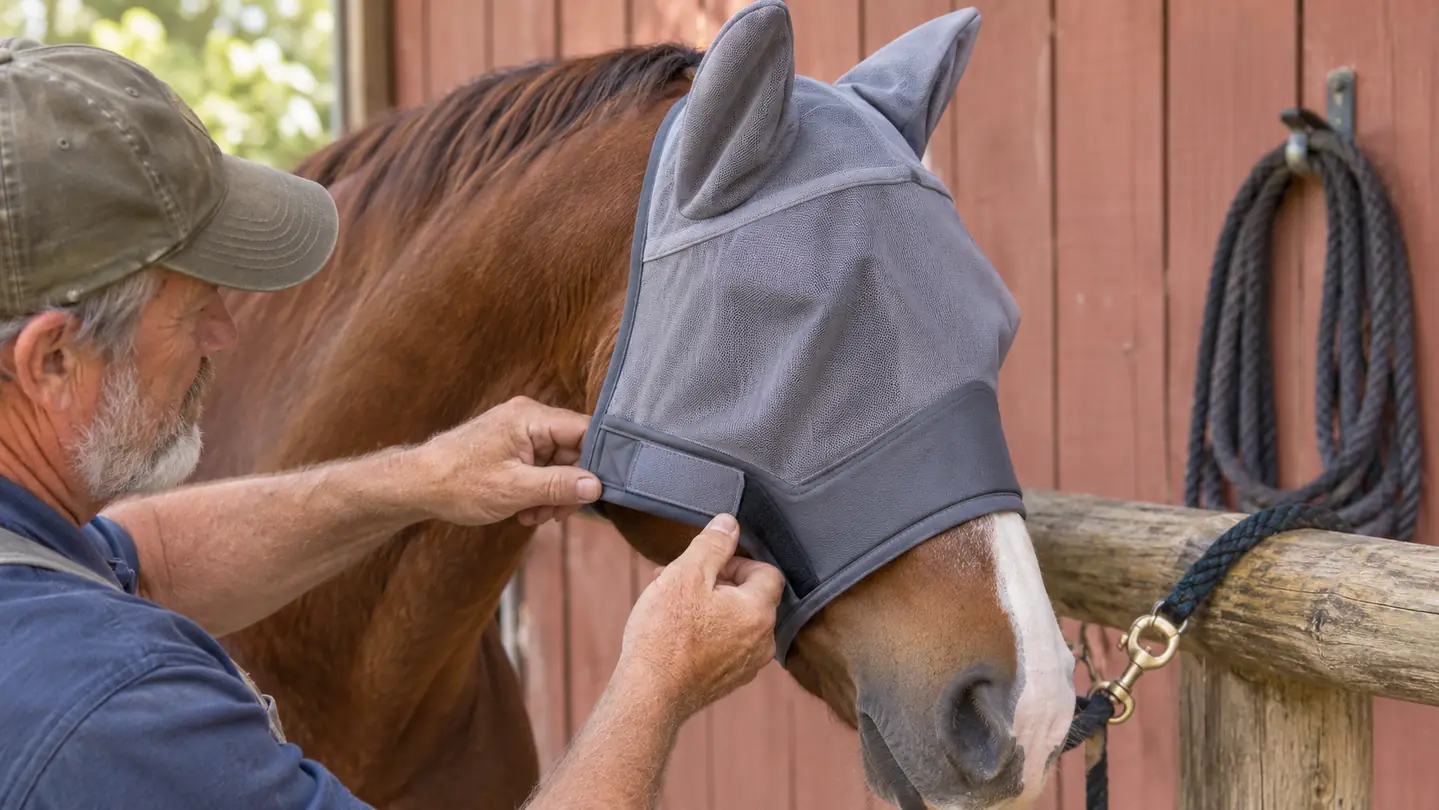
Coverage, first. The CareMaster Pro covers the whole face and it covers the ears. That sounds like a small thing until you own a mare whose ears are the first place flies land. Basic mesh masks usually stop short of the ears or leave them bare, and a horse with bare ears will shake her head hard enough to rub the mask off her own face against a fence post. The Harrison Howard mask also has the large eye space, which mattered more than I expected. The mesh sits off the eye itself instead of resting on the lashes, so there is clearance for blinking and for that little gust of wind that comes with a trot.
Second, the edges. This mask has thick fleece padding where it meets the face, and the shape is described as anatomical, which is marketing language for a mask cut to follow the jaw and cheekbone instead of pulling straight across. What that means in the barn is fewer pressure marks. The cheap mask I used years ago left a faint line across Juni's cheekbones after two hours. This one leaves nothing after a full day of turnout, and the padding is what closes the gaps a horse will find and exploit by rubbing.
Third, it stays where I put it. The touch closures on the Harrison Howard sit flat and hold. I have not had to refasten this mask in the middle of a ride, and that alone is worth something when you are halfway down a trail with one hand on the reins.
Where a Basic Mesh Fly Mask Wins
Airflow. A basic mask is one layer of mesh and almost nothing else. On a 95 degree afternoon in this valley, that matters. Juni sweats under her jaw and down her neck no matter what is on her head, but the plain mask moves air more freely than a padded, ear-covered mask does. If your horse runs hot, or you live somewhere hotter than I do, that is a real advantage and I am not going to pretend otherwise just because I like the other one better.
Weight and fuss. The CareMaster Pro weighs 6.7 ounces, which is not heavy by any measure, but it is still more mask than some horses will tolerate, especially a young one or a horse that has never worn anything on its head. A basic mask goes on in three seconds and comes off in two. And when a horse finally destroys one by dragging it through the fence, you are out very little and you are not emotionally attached to it. There is something to be said for a piece of gear you can treat as disposable.
The mask that survived six weeks of fly season without a rub mark
The CareMaster Pro covers the ears, pads the edges and stays put through a full day of turnout. It is the one I reach for in the dark.
Amazon Check Today's Price on Amazon →What I Actually Checked
I am not a vet and I am not a tester with a clipboard. I am a woman with one horse, five acres and a part time bookkeeping job at a family feed store, so my method was simple. Both masks went on Juni for full days of turnout plus every trail ride for six weeks. I looked at four things: whether flies got inside, whether the mask moved, whether it left marks on her, and whether it came back from the pasture in one piece.
The fly question was not close. On the rides where she wore the CareMaster Pro, I found flies crawling on the outside of the mesh and none underneath it. The mask with ear covers is doing work that a face-only mask simply cannot do, because the ears are where Juni's flies go first. That is not a knock on basic masks as a category. It is just what happens when you cover more of the horse.
What Six Weeks of Fly Season Actually Looked Like
Week one, both masks went on and came off without drama. Week two we did four miles at the regional park and Juni came back with flies on the outside of the CareMaster Pro and none inside it. That is the entire job of a fly mask and it is easy to forget when you are reading product listings that all say the same things.
Week three, the basic mask started slipping. Not falling off, just rotating, so the eye openings ended up a half inch off where they should be. I retied it, snugged it, retied it again, and by the end of that ride I had stopped twice to fix it. On a horse with a narrower head than Juni's I think it would be worse. A single strap and one shape only gets you so far.
Week five, the difference showed up in the pasture instead of on the trail. Juni rubs her face on the fence rail when the flies get bad. That is just what she does. The basic mask picked up a scuff and a small tear at the corner seam from that habit. The CareMaster Pro came through the same week with the fleece padding still intact, no tear, and no rub marks on the horse. That is the trade you are actually making. More money upfront, less replacing, and a lot fewer ugly pink patches above the eye.
Four miles at the regional park, flies crawling on the outside of the mask and none inside it. That is the entire job, and only one of the two did it.

The Details That Decided It
The mesh is described as translucent fine mesh with lab-tested UV protection, and I will tell you what that looks like from the saddle rather than the lab. I can see Juni's eye through it when I turn around to check on her, which means she can see out. A dense, cheap mesh that you cannot see through is the reason some horses panic the first time they wear a mask. The translucent material also means the sun is not hammering that pink skin above her eye all afternoon, which is the whole reason I started this in the first place.
The fabric is listed as midge-proof and breathable. I cannot prove midge-proof with a notebook, but I can tell you that the little biting gnats that come off the creek in June did not leave the same crusted bites on her face that they did last year. The touch closures are the other detail I notice every single morning, because at 5:30 in the dark I am fastening this by feel and it holds on the first try.
The Ear Question
If you take one thing from this comparison, make it the ears. Ear covers are the single biggest difference between the Harrison Howard CareMaster Pro and a plain mesh mask, and they are the reason I stopped rotating the two evenly. Juni's ear flick is constant in fly season and a bare-eared mask does nothing about it. The ear covers on this mask are part of the same piece of fabric, so there is no separate piece to lose and nothing extra to fasten.
The flip side is honest: more coverage means more warmth, and a horse who genuinely cannot tolerate anything over the ears will fight you. If that is your horse, start with the basic mask and work up. I would rather see a horse in a simple mask than out of one entirely because the fancier version got her wound up.
Who Should Buy Which
Buy the Harrison Howard CareMaster Pro if your horse is thin-skinned, if flies go for the ears, if you have ever found a rub mark or a raw patch above the eye, or if your horse is turned out for long stretches during fly season and you want one mask that covers the whole problem. It is also the better pick if you tack up in the dark and want closures that work without looking. Sized Large, it fits Juni's 15.1 hand Quarter Horse head with room to spare, and the padding means that room is not a gap flies can use.
Buy a basic mesh fly mask if you are introducing a young or head-shy horse to the idea of wearing one, if your climate is brutally hot and airflow beats coverage, if your horse destroys masks on fence rails faster than you can replace them, or if you just want a spare folded in the trailer for the day the good one gets left at the barn. Those are all fair reasons and none of them are a compromise you will regret.
What I would not do is split the difference and only own one kind. My trailer spare has saved a ride twice this summer, once because I forgot the mask on the gate and once because a friend's horse rubbed hers off in a stock trailer. A plain mask in the tack trunk costs almost nothing and it turns a ruined afternoon into a two minute fix. The good mask is what Juni wears. The cheap one is what rides along in case the day goes sideways.
One mask, whole face, ears included
Thick fleece padding, touch closures, translucent fine mesh with lab-tested UV protection. It held up through six weeks of trail season and a mare who rubs her face on the fence.
Amazon See the CareMaster Pro on Amazon →