
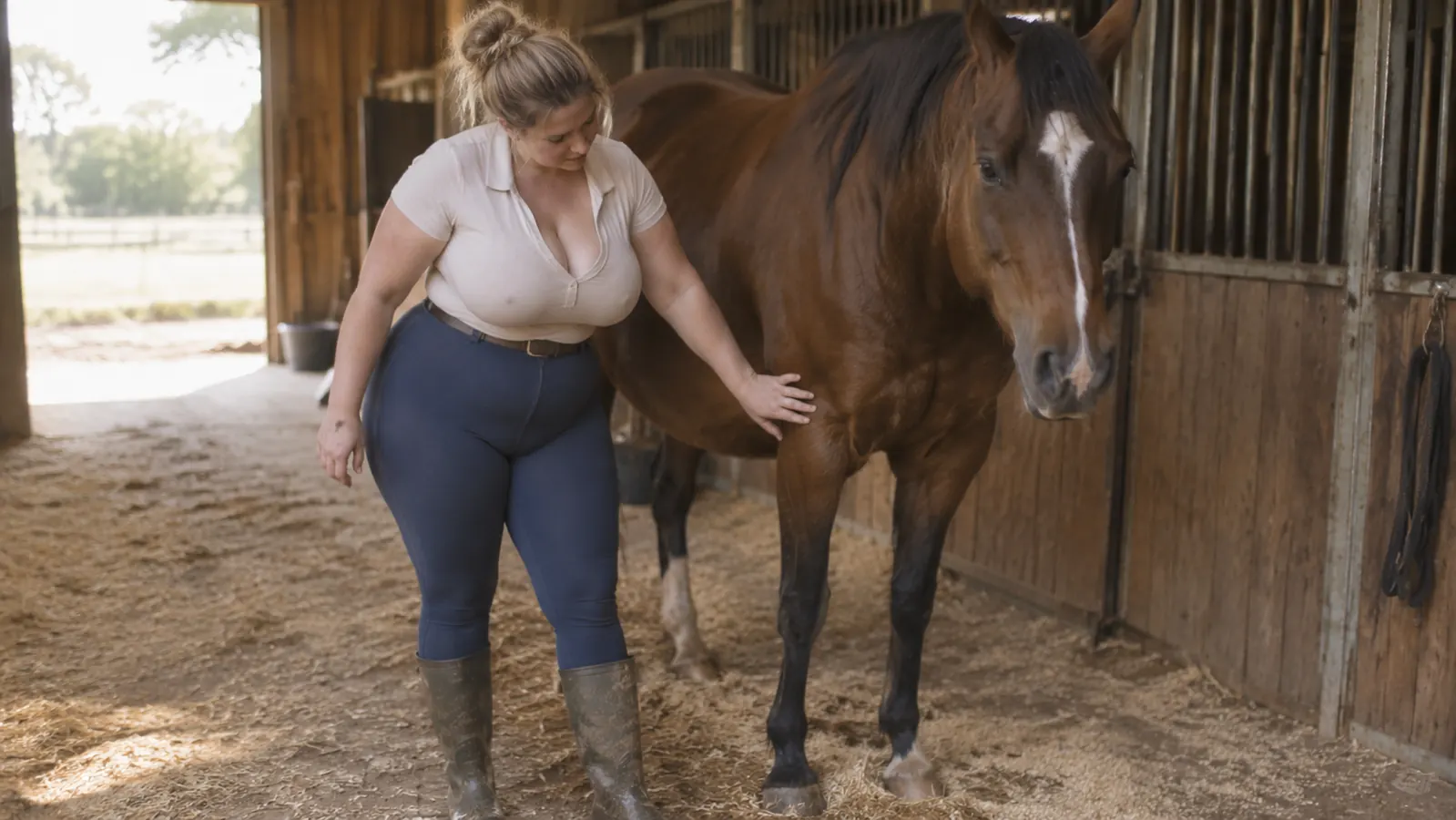
Juniper is a 14-year-old bay Quarter Horse mare, about 1,050 pounds and 15.1 hands, and she has never picked up a foot for me out of generosity. She does it because we have a deal: I show up at the same time every morning with a pick in my pocket, and she gets her grain. That deal took about three weeks to build. In those three weeks she leaned on me, yanked her foot back, and twice pinned me against the stall wall, which is a thing a 1,050 pound animal can do without trying very hard. Nobody at the barn told me to do this daily. I started because a farrier looked at her feet, then looked at me, and asked how often I picked them out.
The tool I reach for now is the BOTH WINNERS hoof pick brush, a two in one with a steel hook on one end and a stiff brush on the other. The reason I like it is boring and practical: one tool comes out of my pocket instead of two, so I actually do the job. The other thing I had wrong for years was the schedule. I treated hoof picking as a Saturday job, something to do before the farrier came, and I was a little proud of myself for it. What I know now is that manure, mud and grit pack into the sole and around the frog within a day or two, and packed material holds moisture right against the foot. On five wet acres in winter, that is a standing invitation to problems I would rather not deal with.
One Tool in Your Pocket, Four Feet Done in Four Minutes
The BOTH WINNERS hoof pick brush is the pick that actually stays on the hook by the stall door, because the brush is already attached to it. Steel hook for packed mud, stiff brush for the sole, soft grip for cold mornings when the gate bites your hand.
Amazon Check Today's Price on Amazon →Step 1: Bolt the Job to Something That Already Happens Every Day
Every hoof-picking plan I have made that began with the word after fell apart. After chores. After my shift doing the books at the feed store. After the softball tournament, when we get home at nine and the last thing I want to do is walk out to the barn with a tool. What survives is a job attached to something that already has a fixed time, and in a barn the fixed time is feeding. Juniper gets her grain at 5:40 on weekdays and closer to 6:30 on weekends, and she is far more willing to stand while I work when the bucket is in front of her. Grain in the bucket, pick in my hand. That is the entire system, and it works because I do not have to remember it.
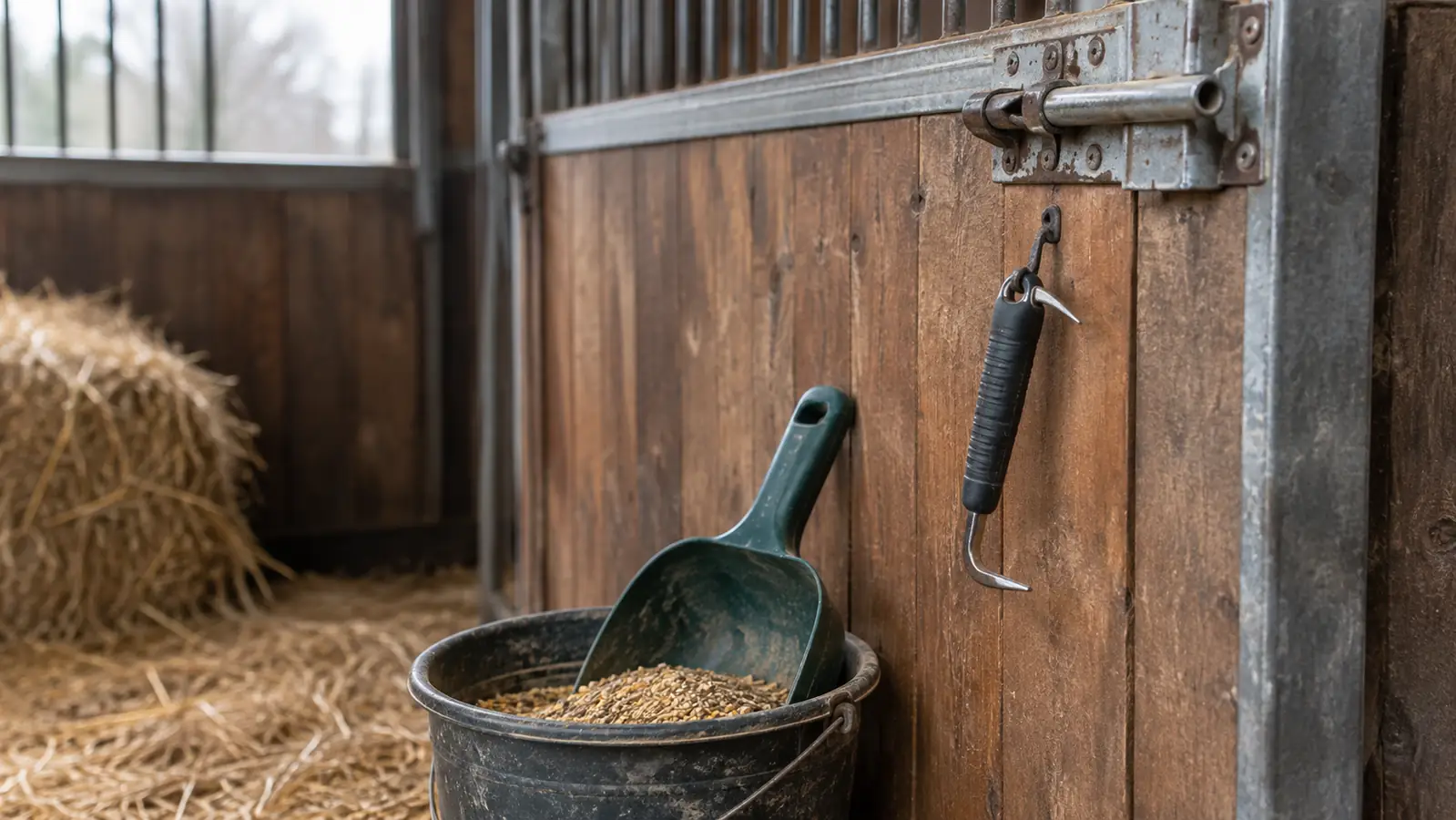
The second half of the habit is location. If the pick lives in the tack room in a bucket under three other things, you will skip it. Mine hangs on a hook by the stall door at shoulder height, where I can grab it with one hand while the other hand is holding a feed scoop. That hook is the reason the BOTH WINNERS pick gets used and the pretty wooden one I bought years ago does not. A tool you have to go find is a tool you will not use twice, and the difference between a horse that gets handled daily and one that gets handled when you get around to it comes down to about eighteen inches of walking.
Four feet take me about four minutes now, and that includes the brushing. If you are starting out, budget ten and expect it to feel clumsy for a week. The point of daily is not speed, it is frequency. A horse handled every day tells you something about that horse. A horse handled on Saturdays tells you what happened on Saturday, which is not the same thing at all.
Step 2: Stand Where the Horse Can Do the Lifting
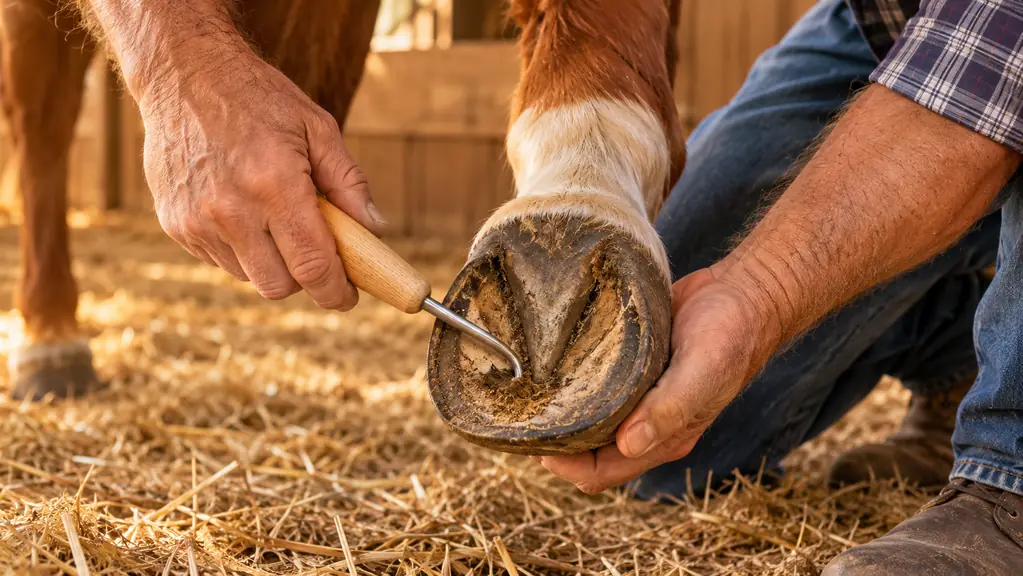
Stand beside the horse's shoulder, facing the tail, with your feet out of the strike zone. Run your near hand down the leg from shoulder to fetlock before you ask for anything, then squeeze the tendon just above the fetlock and lean your shoulder in slightly. Most horses pick up within a second or two. If one does not, do not wrestle the leg up with your back and do not turn it into a fight you will lose. Find out why instead. Juniper went through a month where she refused the left hind, and the answer was a heel I had not looked at closely enough. That was a lesson about paying attention, not about strength.
For a hind leg, step forward toward the shoulder so the horse has to shift weight off that foot, then hold the leg under the hock with the hoof at roughly knee height. Do not pull a hind leg out behind the horse. That is how people get kicked, and it is also how a horse learns that picking up a hind foot means being dragged off balance. Keep your own back straight, bend your knees and let the horse carry the weight of the leg. You are not lifting 1,050 pounds. You are asking for a foot and then getting out of the way of the answer.
If the horse leans on you, put the foot down, reset your stance and ask again. Two or three tries is normal. Ten is a horse telling you something. If the foot is hot, or the horse flinches when you run a hand down the leg, stop and call your farrier or vet. A horse that suddenly will not give a foot it gave yesterday has a reason, and the reason is usually in that foot. I am not a vet, a farrier or a trainer, and the times I have ignored that signal are the times it cost me.
Step 3: Work the Hook Heel to Toe and Leave the Frog Alone
Start at the heel bulbs and draw the hook toward the toe in one motion, in the groove on each side of the frog. Packed material comes out in a plug and lands on the barn floor, and if it comes out in one piece you know you got all of it. Work around the frog, not into it. The central sulcus is a deep, narrow groove and a steel hook is not the tool for digging down inside it. A hoof pick is for the stuff that does not belong in the sole. The frog belongs there, and it is softer than it looks from the outside.
This is where a pick either earns its place or gets thrown across the barn. The hook on the BOTH WINNERS pick is reinforced with steel, so it does not flex when you are working under a packed ball of clay and shavings after a wet week. I have bent cheap picks into a curve in a single morning, and once a bent pick is in your hand you stop trusting it and start skipping feet. Skipped feet are how you end up with a problem you find three weeks later. A hook that holds its shape means you finish all four, every time, including the ones that take a little more work.
In mud season, expect to go around the sole twice. The first pass loosens the plug, the second gets what was underneath it. Do not pry at a loose shoe, do not dig at a crack, and do not lever against the white line to see what happens. If the pick catches on something solid and does not give, stop and look at it in better light with a stiff brush instead. That is a farrier call, not a hoof pick call, and no tool in your pocket changes that.
Three weeks of showing up at 5:40 with a pick in my pocket, and Juniper quit bracing her foot against my hand. Nothing about the pick taught her that. The repetition did, and the pick made the repetition easy enough to keep.
Step 4: Flip to the Brush and Finish What the Hook Started
The brush is the half people skip, and it is the half that makes the job worth doing. Once the plug is out, run the brush across the sole, around the edges of the frog and back over the heel bulbs. That clears the fine grit the hook leaves behind, and fine grit is what packs back in first the next time the horse steps into mud. I also brush down the outside of the hoof wall when the mud has dried, because I would rather knock it off with a brush than chip at it with a pick and end up with a ragged spot near the coronet band.
The handle matters more than I expected, and I say that as someone who assumed grip was marketing talk. The BOTH WINNERS pick has a soft touch handle, and on a January morning in Hollister, when the metal on the gate bites through thin gloves, that grip is the difference between a controlled stroke and a jab. A controlled stroke is the entire point. The pick goes where you aim it, and it stays away from the parts of the foot that will make your horse remember the experience badly.
The brush has a second life, which is why it stays in my jacket pocket after the hooves are done. It gets mud off the pick itself, it clears shavings out of the feed scoop, and it scrubs the latch on the paddock gate when that starts sticking in the rain. One tool doing three jobs means I am not walking back to the tack room in the dark to find the right thing. That is worth more to me on a weekday morning than any feature printed on a package.
Step 5: Look at What Came Out Before You Dump It
The last step takes no extra time and it is the reason daily picking earns its four minutes. Before you tip the pick out, look at what is on it. Dark, greasy, smelly material from around the frog is worth a conversation with your farrier and probably your vet, especially if the smell stays with you after you walk away. Dry, crumbly grit and shavings are normal. A little dirt and a lot of nothing is exactly what you want to see on a Tuesday in February.
Then run a hand down each leg and feel the hoof wall. Heat that was not there yesterday, a crack that has grown since you started looking, a shoe that has moved, or a spot at the heel that makes the horse flinch all go on the list. Wet weeks are when Juniper's heels get dry and cracked and when rain rot shows up on her pasterns, so I check those in the same pass while my hand is already down there. I am not diagnosing anything. I am noticing early and asking someone qualified sooner than I used to.
I keep the notes in my phone, one line per day, because I forget everything that is not written down. Two weeks of one line per day is what let my farrier see that a crack was moving instead of guessing from a single afternoon. It also settled a long argument with myself about whether a change I made in her footing was doing any good. Four words a day is a small thing to ask, and it has answered questions that no amount of squinting at a hoof ever did.
What Else Helps
Pick after you ride, not just in the morning. A stone packed into a hoof on the trail does its damage during the walk back to the trailer, and the pick that lives in the truck is the one that saves you the trip. I keep a spare in the trailer's tack box for exactly that reason, and it has been used on other people's horses more often than my own. Picking out a stranger's horse at a trailhead is a quick way to make a friend, and it takes about a minute.
Clean the tool itself once a week. Hose the brush off, knock the mud out of the hook, dry it, and hang it back on the hook by the stall door. A pick left sitting in a wet bucket grows a layer of barn crud that you then transfer to the next hoof, which defeats the point of the whole exercise. Put your farrier's next date on the calendar and keep it. Daily picking supports good shoeing, it does not replace it. And anything that smells wrong, feels warm, or changes how your horse moves is a question for your vet or farrier, not for a woman with a hoof pick and a phone full of notes.
The Pick That Stays on the Hook by the Stall Door
Four minutes a day, one tool with a steel hook and a stiff brush, and a habit that survives mud season, dark mornings and a full weekend of softball. The BOTH WINNERS hoof pick brush is the one I reach for before the grain bucket is empty.
Amazon Check Today's Price on Amazon →